

Smart Toilet Market Demand Fuels Growth from USD 10.01 Billion in 2026 to USD 22.67 Billion by 2035
Smart Toilet Market
Smart Toilet Market Size, Share and Research Report By Type (Wall Hung Toilet, Close-Coupled, Single Floor Standing Toilet, One-Piece Toilet), By Connectivity
Smart Toilet Market is gaining momentum with increasing demand for connected bathroom solutions, hygiene technologies, water-saving features, and smart home integration.”
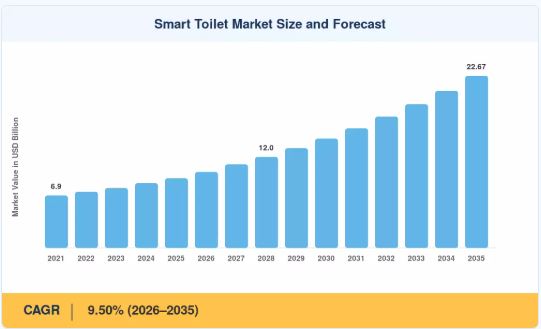
PARIS, PARIS, FRANCE, July 31, 2026 /EINPresswire.com/ -- The Global smart toilet market reached an estimated USD 9.14 billion in 2025 and is projected to grow from USD 10.01 billion in 2026 to USD 22.67 billion by 2035, registering a CAGR of 9.50% during the forecast period. Two major catalysts are accelerating this trajectory: the rapid integration of IoT-enabled hygiene technology into premium residential and hospitality construction projects globally, and the accelerating adoption of bidet-integrated intelligent toilet seats driven by heightened post-pandemic hygiene awareness. With smart home renovation spending surpassing USD 180 billion annually across developed economies, homeowners, hotel operators, and healthcare facility managers face mounting pressure to upgrade bathroom infrastructure or risk losing competitive appeal and operational efficiency.— Market Research Future (MRFR)
Legacy ceramic toilet fixtures many lacking any electronic functionality whatsoever are rapidly giving way to sensor-equipped intelligent platforms that integrate heated seating, auto-open/close lids, self-cleaning nozzle systems, air deodorizers, and health-monitoring capabilities. A recent Frost & Sullivan survey estimated that top-quartile luxury hospitality brands deploying smart toilet systems alongside connected bathroom analytics achieved 19–23% higher guest satisfaction scores than peers still relying on conventional sanitary fixtures. This technology shift is not incremental it represents a structural re-platforming of how the global bathroom industry defines hygiene, comfort, and wellness.
Get Full PDF Sample Copy of Report: (Including Full TOC, List of Tables & Figures, Chart) @
https://www.marketresearchfuture.com/sample_request/5720
➤ How Significant Is the Smart Toilet Market’s Growth?
The smart toilet market has demonstrated consistent and robust expansion, rising from approximately USD 4.12 billion in 2021 to an estimated USD 9.14 billion in 2025, representing a healthy historical growth trajectory. The market is expected to more than double over the next decade, driven by increasing disposable incomes in emerging economies, the growing prevalence of smart home ecosystems, and heightened consumer awareness of personal hygiene and wellness technology.
Rising urbanization rates, premium residential construction booms across Asia-Pacific and the Middle East, and the growing elderly population requiring hygiene-assistive bathroom technologies have created acute demand for intelligent toilet systems. Hospitality chains, healthcare providers, commercial real estate developers, and luxury homebuilders are all investing heavily in smart toilet installations to reduce maintenance overhead, enhance user experience, and align with increasingly prevalent green building certification requirements.
➤ What Does the Future Hold for the Smart Toilet Market?
Health monitoring integration and AI-driven personalization stand at the forefront of the market’s next growth phase. Next-generation smart toilets are evolving from comfort-focused fixtures into active wellness monitoring platforms. Embedded biosensors capable of analyzing urinalysis parameters including glucose, protein, and ketone levels are beginning to reach commercial availability, positioning the smart toilet as a passive, frictionless component of preventive healthcare ecosystems.
The growing emphasis on water conservation and sustainable bathroom design is another defining force shaping the market’s future. Dual-flush and precision water volume control systems embedded in smart toilets are helping residential and commercial users meet increasingly stringent WaterSense, WELS, and LEED certification standards. Platforms offering real-time water usage dashboards, leak detection alerts, and consumption benchmarking are seeing strong adoption among sustainability-focused property developers and facility managers.
Voice control and smart home ecosystem integration is also redefining the user experience. With native compatibility with Amazon Alexa, Google Home, and Apple HomeKit becoming standard in premium product lines, smart toilets are transitioning from standalone fixtures into fully connected nodes within broader smart home and building management systems enabling automated routines, multi-user preference profiles, and seamless integration with bathroom lighting, ventilation, and heating controls.
Buy this Premium Research Report at:
https://www.marketresearchfuture.com/checkout?currency=one_user-USD&report_id=5720
➤ Who Are the Key Players in the Smart Toilet Market?
The smart toilet landscape is characterized by a mix of established global sanitary ware manufacturers, diversified bathroom products conglomerates, and emerging wellness-focused technology startups. Key participants shaping the competitive dynamics include:
TOTO Ltd. — the global pioneer of integrated bidet toilet technology, commanding dominant market share across Japan, North America, and key export markets
Kohler Co. — delivering premium smart toilet and intelligent toilet seat systems with deep Amazon Alexa and Apple HomeKit integration
LIXIL Corporation (American Standard / GROHE) — offering globally distributed smart sanitary ware under multiple regional brand identities
Roca Group — providing design-forward intelligent toilet solutions across European, Latin American, and Asian markets
Duravit AG — specializing in architect-grade smart bathroom systems combining Scandinavian design aesthetics with advanced electronic functionality
Geberit AG — delivering integrated in-wall cistern and intelligent toilet seat systems with a strong presence in the European commercial construction segment
Panasonic Corporation — offering electronic bidet toilet seats and integrated smart bathroom products across Japan and Asia-Pacific
Brondell Inc. — serving the North American mid-market with a comprehensive lineup of bidet seats and smart toilet accessories
Bio Bidet (Bemis Manufacturing) — providing accessible intelligent toilet seat products across residential and ADA-compliant commercial segments
SmartBidet — targeting value-conscious consumers with entry-level electronic bidet toilet seat technology across e-commerce channels
Competition in the market is intensifying as vendors race to embed health-sensing biosensor arrays, expand voice-control ecosystem compatibility, and deepen integrations with smart home platforms and building automation systems. Strategic partnerships with healthcare technology companies, interior design firms, and luxury property developers are also reshaping the vendor landscape.
➤ What Are the Emerging Trends in the Smart Toilet Market?
Several transformational trends are redefining how the smart toilet market evolves through 2035:
Health & Wellness Monitoring Integration: Embedded biosensors capable of passive urinalysis for glucose, hydration, and biomarker tracking are transitioning smart toilets from hygiene appliances into preventive healthcare devices a development poised to reshape health insurance and telehealth partnerships.
AI-Powered Personalization: Machine learning algorithms enabling automatic adjustment of water temperature, pressure, seat heating, and bidet nozzle positioning based on individual user profiles and usage history are becoming key premium differentiators.
Voice Control & Smart Home Ecosystem Connectivity: Native integration with Alexa, Google Home, and Apple HomeKit, alongside Matter protocol compatibility, is enabling smart toilets to function as coordinated nodes within fully automated bathroom and home environments.
Self-Cleaning & Antimicrobial Technology: Electrolyzed water cleaning systems, UV-C sterilization of nozzles and bowl surfaces, and silver-ion antimicrobial ceramic coatings are addressing consumer hygiene expectations elevated significantly by the post-COVID-19 environment.
Water Conservation & Sustainability Features: Precision dual-flush systems, greywater recycling integration, and real-time consumption monitoring dashboards are enabling smart toilets to contribute meaningfully to green building certifications (LEED, BREEAM, WELS) across residential and commercial projects.
Aging-in-Place & Accessibility Design: Smart toilets featuring automated lid actuation, adjustable seat height, built-in nightlights, fall-detection sensors, and emergency alert capabilities are addressing the rapidly growing global elderly population’s need for hygiene-assistive bathroom technologies.
Get access to the full description of the report @
https://www.marketresearchfuture.com/reports/smart-toilet-market-5720
➤ How Is the Smart Toilet Market Segmented?
The smart toilet market report provides a comprehensive segmentation framework:
1 By Product Type: Integrated Smart Toilets, Smart Toilet Seats / Bidet Attachments, Smart Toilet Accessories
2 By Technology: Sensor-Based, Voice-Controlled, App-Controlled, AI-Integrated
3 By End-Use: Residential, Hospitality, Healthcare & Assisted Living, Commercial & Corporate, Public Infrastructure
4 By Distribution Channel: Specialty Bathroom Retailers, Online E-Commerce, Direct-to-Consumer, AV & Smart Home Integrators
5 By Price Tier: Premium (Above USD 1,500), Mid-Range (USD 500–1,500), Entry-Level (Below USD 500)
➤ What Are the Regional Insights from the Smart Toilet Market?
Asia-Pacific commands approximately 41% of global smart toilet market share the highest of any region underpinned by Japan’s decades-long cultural embrace of electronic bidet toilet technology (where smart toilet penetration in households exceeds 80%), China’s rapidly expanding premium residential construction sector, and South Korea’s highly tech-receptive consumer base. TOTO, Panasonic, and LIXIL’s regional dominance reinforces APAC’s leadership position.
North America holds the second-largest share at approximately 28%, driven by the booming home renovation market, rising adoption of smart home ecosystems across suburban and luxury residential segments, and growing awareness of bidet technology among hygiene-conscious American and Canadian consumers. The region’s mature e-commerce infrastructure has dramatically lowered the barrier to entry-level smart toilet seat adoption.
Europe represents the third-largest market at approximately 19%, with Germany, the United Kingdom, and the Scandinavian countries leading adoption. Regulatory emphasis on water efficiency standards, the BREEAM green building certification framework, and a strong culture of bathroom design investment are primary growth drivers. The region’s aging population is also creating structural demand for accessibility-focused intelligent toilet solutions.
Middle East & Africa is projected to register the highest CAGR at approximately 9.1% through 2035. Landmark luxury hospitality and real estate mega-projects across Saudi Arabia, the UAE, and Qatar including NEOM, Dubai Creek Harbour, and Lusail City are generating exceptional demand for ultra-premium smart bathroom fixture specifications.
South America rounds out the global picture, with Brazil and Chile representing the most active markets for smart toilet adoption, primarily within the luxury residential and five-star hospitality segments.
➤➤➤ Industry Analysis Reports by Market Research Future:
In Pipe Inspection Robot Market-
https://www.marketresearchfuture.com/reports/in-pipe-inspection-robot-market-26579
Microscope Digital Camera Market-
https://www.marketresearchfuture.com/reports/microscope-digital-camera-market-26692
Memory Device Market-
https://www.marketresearchfuture.com/reports/memory-device-market-26959
Led Light Bar Market-
https://www.marketresearchfuture.com/reports/led-light-bar-market-26966
Solar Shading System Market-
https://www.marketresearchfuture.com/reports/solar-shading-system-market-26972
Lcr Meter Market-
https://www.marketresearchfuture.com/reports/lcr-meter-market-27420
Analog Security Camera Market-
https://www.marketresearchfuture.com/reports/analog-security-camera-market-28252
3D Cinema Screen Market-
https://www.marketresearchfuture.com/reports/3d-cinema-screen-market-28766
4K Satellite Broadcasting Market-
https://www.marketresearchfuture.com/reports/4k-satellite-broadcasting-market-28772
Commercial Display Market-
https://www.marketresearchfuture.com/reports/commercial-display-market-28777
Sagar Kadam
Market Research Future
+ + +1 628-258-0071
email us here
Legal Disclaimer:
EIN Presswire provides this news content "as is" without warranty of any kind. We do not accept any responsibility or liability for the accuracy, content, images, videos, licenses, completeness, legality, or reliability of the information contained in this article. If you have any complaints or copyright issues related to this article, kindly contact the author above.
